

Thank you for writing to us. One of our executive will reach back to you through your submitted medium. In case there’s an urgency, feel free to connect over WhatsApp for faster response.
Prefer calling? Dial +919511719169 (International callers) or +919511719169 (Indian callers).
Other Services
Procurement of Class 3 DSC (Validity 2 Years) for Individuals and Organizations - Signing and Encryption
Certifications of E-forms as required under the Companies Act, 2013
Certification of MGT 8
Filing annual returns with the Registrar of Companies (ROC)
Organizing the board and general meetings
Maintaining statutory registers, common seal, minutes books for the board and general meetings, and issue of share certificates
Assisting in preparing notices, agendas, minutes, and resolutions of board meetings, and general meetings
Filing periodical forms for matters relating to directors, capital structure, the shifting of the registered office, alterations in the memorandum, and articles of association
Drafting and Vetting of Agreements including but not limited to Shareholders Agreement, Share Purchase Agreement, Restructuring Agreement, Bonus Entitlement Agreement, etc.
Due Diligence Report, Brisk Reports, Search Report
Fund and Investment Consultancy
Organization Closure/Winding Up
Quick Track Merger
FSSAI license Consultant/Agent
ISO certifications
Food License
IEC Code Registration
80G 12AA Registration for NGO/society
RO Shifting one state to another state
AGM extension consultant

INSOLVENCY AND BANKRUPTCY PRACTICE
Our team have handled various insolvency and bankruptcy matters under the Insolvency and Bankruptcy Code, 2016 and Regulations made thereunder, before the Adjudicating Authority (NCLT) and Appellate Authority (NCLAT). We have made representations to various regulators, authorities, tribunals and appellate tribunals and have reported case laws on this subject.
Our services under Insolvency and Bankruptcy Practice areas are as under:
Study, analysis and advisory on commencement of insolvency or bankruptcy proceedings against companies, LLPs and individuals
Drafting of application and representing financial creditors against corporate debtors for commencement of Corporate Insolvency Resolution Process (CIRP) before the Adjudicating Authority
Drafting and issue of demand notice on behalf of operational creditors
Drafting of application and representing operational creditors against corporate debtors for commencement of Corporate Insolvency Resolution Process (CIRP) before the Adjudicating Authority
Drafting of application and representing corporate debtor for commencement of Corporate Insolvency Resolution Process (CIRP) before the Adjudicating Authority
Drafting of application and representing corporate debtor for commencing liquidation proceedings
Representation and pleadings against application for commencement of Corporate Insolvency Process (CIRP) before Adjudicating Authority
Drafting of appeals and representation before Appellate Authority against decision of Adjudication Authority
Drafting of Resolution Plan
Designing Evaluation Matrix for evaluation of Resolution Plans
Implementation services of Resolution Plan
Transaction advisory in respect of corporate or capital restructuring during CIRP
Transaction advisory for commencement of liquidation process
Transaction advisory for voluntary liquidation of companies
Advisory and opinions on questions of law under the Insolvency and Bankruptcy Code, 2016 and Regulations made thereunder
We have CS IP Murli Lahoti, a registered Insolvency Professional and member of the Institute of Company Secretaries of India (ICSI), who has handled Corporate Insolvency Resolution Process (CIRP) and Liquidation of Companies. He can render the following services.
Officiating as
Interim Resolution Professional (IRP) upon commencement of CIRP
Resolution Professional (RP) upon commencement of CIRP
Company Liquidator (CL) for liquidation of companies
Representing financial creditors or operational creditors in meetings of Committee of Creditors (CoC) during CIRP of corporate debtors.
XBRL Filing and Data Conversion
With the help of our expert group, we have been providing XBRL Conversion Services since 2011. These services are rendered by our professionals while keeping in mind the precise requirements of clients. To render these services, our skilled professionals use advanced techniques and approaches. Besides, our valuable clients can avail of these services from us in customized solutions and at market-leading rates. Our offered services are acknowledged for timely execution (i.e., four hours after providing all the information and records).
Call for Demo: Complete Balance Sheet can be Prepared, Validated, and Pre-Scrutinized in Demo Version.
Applicability of XBRL
Many individuals or organizations are puzzled about the relevance of XBRL (Filing of Documents and Forms in Extensible Business Reporting Language). MCA issued a Notification on 06th November 2017, regarding the clarification on the mandatory relevance of XBRL on specific Companies. These guidelines may be known as the Companies (Filing of Documents and Forms in Extensible Business Reporting Language), Amendment, Rules, 2017.
Filing of financial statements with Registrar: The following categories of companies will file their financial statements and other reports under section 137 of the Act with the Registrar in e-form AOC-4 XBRL as per Annexure-I:
Companies LISTED with stock exchanges in India and Their Indian Subsidiaries;
Companies having Paid-Up Capital of Five crore rupees or above;
Companies having Turnover of One Hundred crore rupees or above;
All companies which are required to prepare their financial statements as per Companies (Indian Accounting Standards) Rules, 2015.
Exempted Companies:
Non-Banking Financial Companies;
Housing Finance Companies; and
Companies engaged in the Business of Banking and Insurance Sector.
FEMA / RBI MATTERS – ADVICE & SUPPORT
Foreign Investments in India are administered by different Acts. The FEMA is one such Act. The Firm offers different consultative and compliance administrations to organizations to facilitate their treatment of various aspects of the FEMA. The Firm also offers advice and services for various Foreign Direct Investment related issues.
These services are broadly offered under the following categories:
Consultation and Compliance – Inbound and Outbound Investments
Advice and legal opinions under FEMA
Investment strategy for Foreign Companies
ECB processing
Identification of suitable partners for seeking ventures
Partnership negotiations
Applications under Foreign Contribution Regulation Act (FCRA)
Required endorsements for FDI from Government Agencies like RBI, FIPB and so on.
Compliances under FEMA.
Handling applications under Foreign Contribution Regulation Act (FCRA)
Compounding of FEMA Offenses
TRADEMARK
Trademarks represent distinctive signs used to identify goods or services offered by a particular company. They encompass designs, symbols, words, or phrases, playing a crucial role in distinguishing products in the market. Trademarks, considered intellectual property, enjoy legal protection against infringement under the Trademark Act of 1999.
Registering a trademark is vital as it prevents unauthorized use and misrepresentation of your mark by others. Well-established trademarks, like Nike's iconic tick or Puma's leaping wildcat, instantly evoke brand recognition and value.
Unlike patents, trademarks have no fixed expiration period. While patents last for 20 years, trademark registrations remain valid for 10 years from registration. However, trademarks can be indefinitely renewed every 10 years, ensuring continuous protection under the law.
Importance of Trademark Registration:
Legal Protection: Shields against counterfeit and deceptive products.
Brand Recognition: Simplifies product identification through name or logo.
Intangible Asset: Creates a transferable, saleable, or franchisable asset.
Building Trust: Establishes goodwill and trust among customers, fostering brand loyalty.
Filing a Trademark Application in India:
Any individual, company, or Limited Liability Partnership (LLP) may file a trademark application. The applicant declared in the registration form becomes the trademark owner upon successful registration.
Documents Required for Trademark Registration in India:
Applicant's name, address, and nationality.
Details of goods/services for registration.
Trade Mark Entity classification (individual, startup, or small enterprise).
Soft copy of the trademark.
Use details (date of first use in India or proposed use).
Power of Attorney signed by the authorized representative.
Types of Trademarks:
Product Mark: Identifies goods rather than services.
Service Mark: Identifies services provided.
Collective Mark: Used collectively by a group of companies.
Certification Mark: Certifies origin, material, or quality of goods/services.
Shape Mark: Includes the shape of goods or packaging.
Pattern Mark: Consists of identifiable patterns.
Sound Mark: Represents sounds associated with products or services.
Trademark Registration Process in India:
Trademark Searches
Trademark Documents Drafting
Trademark Application Filing
Examination of Trademark Application
Publication of Trademark Application
Trademark Registration
Trademark registration, a critical step in protecting your brand, ensures legal recognition and exclusivity in the market
SECRETARIAL AUDIT
Secretarial Audit is an independent process assuring to add value and improve an organization’s operations. It helps to bring a systematic, disciplined approach to evaluate and improve the effectiveness of risk management, control, and governance processes.
An audit is to be on the principle of “Prevention is better than cure”. It strengthens the image and goodwill of a company in the minds of regulators and stakeholders. It acts as an effective compliance risk management tool or a governance tool.
The benefits are available to the following stakeholders of the company:
Promoters
Executive directors
Officers of the company
Regulators
Government authorities
Investors
Banks
Creditors and consumers and others
SECRETARIAL AUDIT IS A PROCESS
To check compliance with the provisions of various laws and rules/regulations/procedures, maintenance of books, records etc.
By an independent professional
To make sure that the legal and procedural requirements are complied with
Also followed the due process
It is essentially a mechanism to monitor compliance with the requirements of stated laws
SECRETARIAL AUDIT REPORT
Every company to which the secretarial report applies:
It shall be prepared by a Company Secretary in Practice
It shall be prepared in Form MR 3
Annexed with Board’s Report, considering the increasing importance of Corporate Governance
APPLICABILITY:
As per section 204 of the Companies Act, 2013 read with Companies (Appointment and Remuneration of Managerial Personnel) Rules, 2014, following companies are required to obtain ‘Secretarial Audit Report’ from independent practicing company secretary:
Every listed company
Every public company having a paid-up share capital of Fifty crore rupees or more
Every public company having a turnover of Two Hundred Fifty crore rupees or more
Every company having outstanding loans or borrowings from banks or public financial institutions of one hundred crore rupees or more.
For the purposes of this sub-rule, it is hereby clarified that the paid-up share capital, turnover, or outstanding loans or borrowings as the case may be, existing on the last date of the latest audited financial statement shall be taken into account.
Secretarial Audit is also mandatory for a private company which is a subsidiary of a public company, and which falls under the prescribed class of companies.
DEMERGER
Demerger, in corporate terms, refers to the division or splitting of a company into several smaller entities. It's important to note that the newly formed companies may not necessarily become subsidiaries of the parent company post-split.
In simpler terms, a demerger entails the corporate partitioning of a company into smaller entities. One entity remains under the parent company's ownership, while others may operate independently, be acquired by other entities, liquidated, or sold off.
Types of Company Demergers
Spin-off:
Involves creating a subsidiary with a portion of the parent company's shares.
Allows the subsidiary to make independent decisions and strategies for specific products, enhancing control over related business operations.
Split-up:
Results in the creation of a single holding company and subsidiaries from the parent company.
Each subsidiary operates independently under different management to manage diversified business areas effectively.
Split off:
Involves selling a business vertical of the parent company to a separate entity.
Done when a company wants to divest from specific markets, products, or areas.
Equity carve-out:
Involves the parent company reducing its holding in one of its subsidiaries.
Provides financial gains but reduces the parent company's shareholding in the subsidiary.
Divestment:
Conducted by the government, reducing its holdings in Public Sector Undertakings (PSUs) by selling its stakes.
A strategic move to exit certain business sectors or raise funds to reduce fiscal deficit.
Divestiture:
Similar to divestment but can be executed for any public or private limited company.
Aimed at financial gain and may occur when an organization seeks to change its investment strategy.
Companies opt for demergers due to various reasons:
Restructuring to adapt to changing political and economic environments.
Optimizing resource utilization and exploiting opportunities effectively.
Exiting unprofitable business ventures or sectors.
Generating resources for acquisitions or financial stability.
Capitalizing on profitable opportunities through financial and managerial restructuring.
Process of Demerger: Key Steps
Preparation of Arrangement Scheme
Application to Court for Meeting of Members/Creditors
Obtaining Court's Order for Meeting of Members/Creditors
Notice of Meeting of Members/Creditors
Holding Meeting of Members/Creditors
Petition to Court to Sanction Demerger Scheme
Court's Order on Sanctioning Demerger Scheme
Demergers have been observed in both private and public sectors, with the Reliance Group demerger being a notable example. As India's economic landscape evolves, demergers prove to be effective strategies to navigate the changing business environment.
MERGER AND AMALGAMATION
A merger represents a corporate strategy where two companies come together to operate as a single legal entity. Typically, companies opting for a merger are of equal size and scale in their operations.
Types of Mergers
Congeneric/Product Extension Merger:
Occurs between companies in the same market.
Results in adding a new product to one company's existing product line.
Enhances access to a broader customer base and increases market share.
Conglomerate Merger:
Involves companies in unrelated activities.
Executed to increase shareholder wealth.
Reverse Merger:
Involves companies in different markets but selling similar products.
Aims to access a larger market and customer base.
Horizontal Merger:
Involves companies selling similar products in the same market, directly competing, and sharing the same product lines and markets.
Decreases competition in the market.
Vertical Merger:
Occurs between companies in the same industry but at different levels in the supply chain.
Aims to increase synergies, supply chain control, and efficiency.
Advantages of a Merger
Increased Market Share:
Expands market reach and grows revenues.
Improves standing in the investment community.
Elimination of Competitors:
Mergers may eliminate competition, avoiding duplication and reducing prices.
Disadvantages of a Merger
Communication Gaps:
Different corporate cultures may result in communication challenges affecting employee performance.
Unemployment:
Aggressive mergers may lead to job losses as companies may eliminate underperforming assets.
LLP Conversion
CONVERSION TO LIMITED LIABILITY PARTNERSHIPS (LLP) UNDER THE LLP ACT
The LLP Act encompasses provisions that enable the conversion of firms established under the Indian Partnership Act, 1932, as well as private or unlisted public companies incorporated under the Companies Act, into LLPs. The procedure for conversion is delineated within clauses 58 and Schedules II to IV of the Act.
Pre-requisites for Conversion from Company to LLP
Absence of security interests in the company's assets at the time of application.
All shareholders of the company must become partners in the LLP.
No pending e-Forms for payment or processing related to the company.
No outstanding (unsatisfied) charges against the company.
Submission of at least one balance sheet and annual return post-incorporation.
Conversion Procedure as per Companies Act
Convene a Board Meeting to pass a resolution for the conversion of the company into an LLP.
Reserve the LLP's name using RUN-LLP available on mca.gov.in (not mandatory as it can be reserved along with the LLP incorporation application).
File the form for LLP incorporation (FiLLiP).
File Form-18.
Upon approval of Form-18, the company's status changes to 'Converted to LLP'.
File Form 3 within thirty days of LLP incorporation, attaching the LLP agreement outlining the terms and conditions among partners.
Implications of Conversion to LLP
Dissolution of the private company post-conversion.
Removal of the private limited company's name from the ROC register.
Continued existence of liabilities, obligations, agreements, contracts, and employment terms.
Notification of conversion to relevant authorities and updates to registrations and licenses.
Filing E-Form-14 (Intimation to ROC)
Submission of E-Form-14 within 15 days of receiving the LLP incorporation certificate.
LLP Formation
LLP stands as an alternative corporate structure that amalgamates the benefits of limited liability companies with the flexibility inherent in partnerships. An LLP possesses the unique characteristic of perpetuity, enabling its continued existence regardless of changes in partners. It holds the capacity to engage in contracts and own property under its own distinct identity. As a separate legal entity, an LLP assumes liability to the full extent of its assets. However, the liability of individual partners remains confined to their agreed contributions within the LLP. Furthermore, partners are shielded from joint liability arising from the independent actions or unauthorized decisions of other partners. The formation of an LLP requires a minimum of two partners, with no upper limit on the maximum number. Among the partners, a minimum of two designated partners, individuals by nature, are mandated, with at least one being a resident of India. The roles and responsibilities of designated partners are delineated within the LLP agreement, where they bear direct responsibility for ensuring compliance with the LLP Act of 2008 and the provisions outlined in the agreement. To initiate a business under the Limited Liability Partnership model, registration under the Limited Liability Partnership Act, 2008 is imperative.
Features of LLP
Possesses a separate legal entity akin to companies.
Limits the liability of each partner to their respective contributions.
Offers a cost-effective formation process with reduced compliance obligations.
Imposes no minimum capital contribution requirement.
Advantages of the LLP Form
Operates on the basis of an agreement, facilitating flexibility without imposing stringent legal procedures.
Encourages the amalgamation of professional expertise with financial acumen, fostering innovative and efficient business endeavors.
Sections, Regulations, and Rules Applicable to LLP
Limited Liability Partnership Act, 2008.
LLP Agreement.
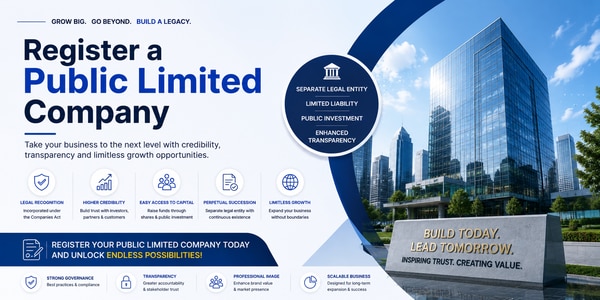
Discover the World of Public Limited Companies
A Public Limited Company, as defined under the Company Act 2013, represents a dynamic entity where member liability is limited, and shares are offered to the general public. These companies can expand their shareholder base through an initial public offering (IPO) or trading on the stock market, offering an exciting opportunity for investment and growth.
Exploring the Traits of Public Limited Companies
Diverse Membership: Public companies must have a minimum of 7 shareholders, with no maximum limit, fostering widespread ownership and participation.
Limited Liability: Shareholders' liability is confined to the unpaid amount on their shares, safeguarding personal assets in cases of company losses or debts.
Perpetual Succession: With a legal persona independent of its members, a Public Limited Company enjoys perpetual existence, unaffected by individual changes in ownership.
Index of Members: Public companies maintain comprehensive records of their members, ensuring transparency and accountability.
Directorship Requirements: A minimum of 3 directors is mandated for public companies, with a maximum of 15, each possessing a Director Identification Number (DIN) issued by the Ministry of Corporate Affairs.
Prospectus Publication: Through the issuance of a prospectus, public companies invite the public to subscribe to their shares, providing detailed information about the company and the shares available for purchase.
Distinctive Naming: The name of a public company typically ends with “Ltd” or “Limited,” distinguishing its corporate identity.
Navigating the Regulatory Landscape
Public Limited Companies operate under the purview of various sections, regulations, and rules, including Section 2(71) of the Companies Act, 2013, and the Companies Incorporation Rules, 2014.
Advantages of Public Limited Companies
Enhanced Credibility: Public limited companies enjoy higher credibility among investors, fostering trust and reliability in the market.
Tax Efficiency: Tax benefits, including deductible costs and allowances, contribute to the financial health of public companies.
Limited Liability: Shareholders are shielded from bearing company debts or losses beyond their investment value, minimizing personal financial risks.
Access to Capital: Public companies can effortlessly raise capital from diverse sources, facilitating business expansion and development.
Expert Governance: Expertly curated boards of directors drive strategic decision-making, ensuring effective leadership and governance.
Business Expansion: Access to additional capital through share issuance propels business growth and expansion opportunities.
Accessible Share Trading: Public company shares are easily tradable on the stock exchange, providing liquidity and convenience to investors.
Risk Diversification: With widespread ownership, risks associated with losses and insolvency are distributed among numerous shareholders.
Understanding One Person Company:
One Person Company (OPC) represents a progressive approach aimed at providing individual entrepreneurs the benefits typically associated with private limited companies.
Introduced under the Companies Act 2013, OPC signifies a pivotal departure from traditional corporate structures. While a minimum of 2 Directors and Members are mandated for a Private Company, and a minimum of 3 Directors and 7 members for a Public Company, OPC revolutionizes the landscape by enabling single-person incorporation, a feat previously unattainable.
Sections, Regulations, and Rules Applicable to OPC
Section 2(62) of the Companies Act, 2013.
Companies Incorporation Rules, 2014 (Rules 3 to 7).
Schedule 1 of the Companies Act, 2013.
Key Features of OPC under the Companies Act, 2013
As per Section 2(62) of the Companies Act, 2013, read in conjunction with Rule 3 of the Companies Incorporation Rules, 2014:
An OPC is defined as a company with only one person as a member.
Only a natural person who is an Indian citizen and a resident in India is eligible to incorporate an OPC or act as a nominee for the sole member of an OPC.
The term “resident in India” refers to a person who has stayed in India for at least One Hundred and Eighty Two Days during the immediately preceding financial year.
Advantages of OPC
Limited Liability: OPC offers extended opportunities with limited liability, restricting liability to the value of shares held.
Separate Legal Entity: OPC enjoys the status of a distinct legal entity capable of conducting business activities.
Fundraising Potential: OPC can readily raise funds to support its operations.
Reduced Compliance Burden: OPC experiences lesser compliance obligations compared to private limited companies.
Enhanced Trust and Reputation: OPCs often garner increased trust and reputation within the industry.
Flexible Structure: OPC can be limited by guarantee or shares, or opt for an unlimited company structure.
Meeting Exemptions: OPCs are not obligated to hold annual general meetings, and provisions regarding meetings and quorum do not apply to them.